
Trust boundary
What has to be true for the read to be verified and stable.
NextConsensus is a specialized measurement system for healthcare claim intelligence. The validation boundary is part of the product.
The discipline the brief must survive
Four things that have to be true before the read is verified and stable.
Every measurement run uses only what was publicly observable at the evaluation timestamp. No future information crosses the boundary. The question at every step: what would have been knowable at the time?
Outcome labels — real decisions like FDA label changes, trial holds, safety communications — are sourced from formal public records and stored independently from the measurement pipeline. The pipeline cannot see labels during computation.
Every validation study compares against explicit baselines: news timing, consensus date, and mention-count benchmarks. The question is not whether the system detected something, but whether it detected something before it was already obvious.
Every study includes failure analysis: when the signal was weak, when the claim was unstable, when contestation was insufficient. Uncertainty is preserved, not compressed into false confidence.
Category education
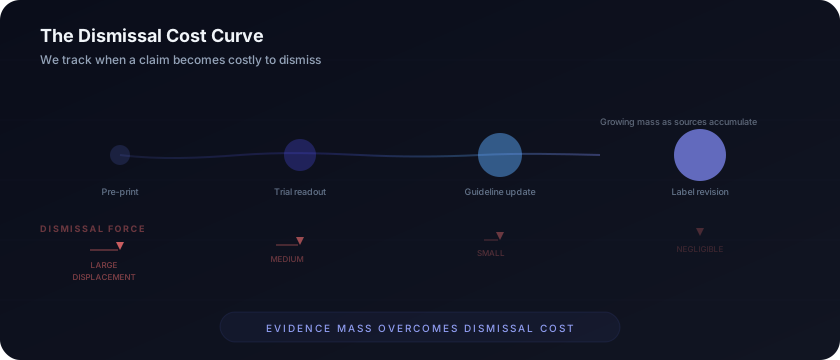
The Dismissal Cost Curve.
A claim does not become important because it exists. It becomes important because supporting sources, failed challenges, and wording stabilization accumulate evidence mass. The same dismissal force — a skeptical reviewer, a competing claim, an adverse mention — moves it less over time. We track when a claim becomes costly to dismiss.
Credibility proof
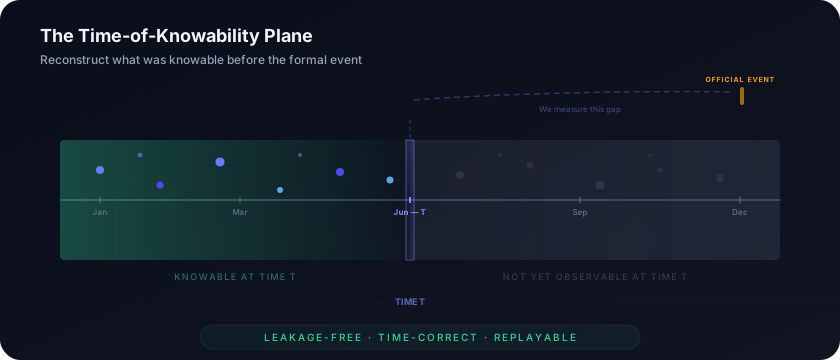
The Time-of-Knowability Plane.
Every measurement run answers one question: what was knowable at the evaluation timestamp? A transparent plane divides observable evidence from future events. Everything to the left was knowable. The official event sits to the right. We measure the gap — and never let the future contaminate the past.
Current authorization
What is authorized for public claims.
Each measurement lane carries its own independent authorization phase. Stronger public claims require clearing quantitative stability gates in a validated backtest.
Threshold transfer statement only; numeric lead-time and holdout claims are frozen pending active production audit
Threshold transfer statement only
Seeded visibility replay passed (0.75); no public claims
Seeded visibility replay passed (0.55); no public claims
Seeded visibility replay passed (0.53); no public claims
No public claims
Validation Boundaries
- The validation boundary is part of the product.
- We do not predict outcomes. We show how the claims behind decisions are changing.
- Public numeric claims remain frozen until validation gates clear.
- Exact signal values and promotion criteria are disclosed only inside private briefs.
Action
Request a technical briefing on validation methodology.
One session, scoped to validation architecture and the current authorization posture. Not a sales pitch.